

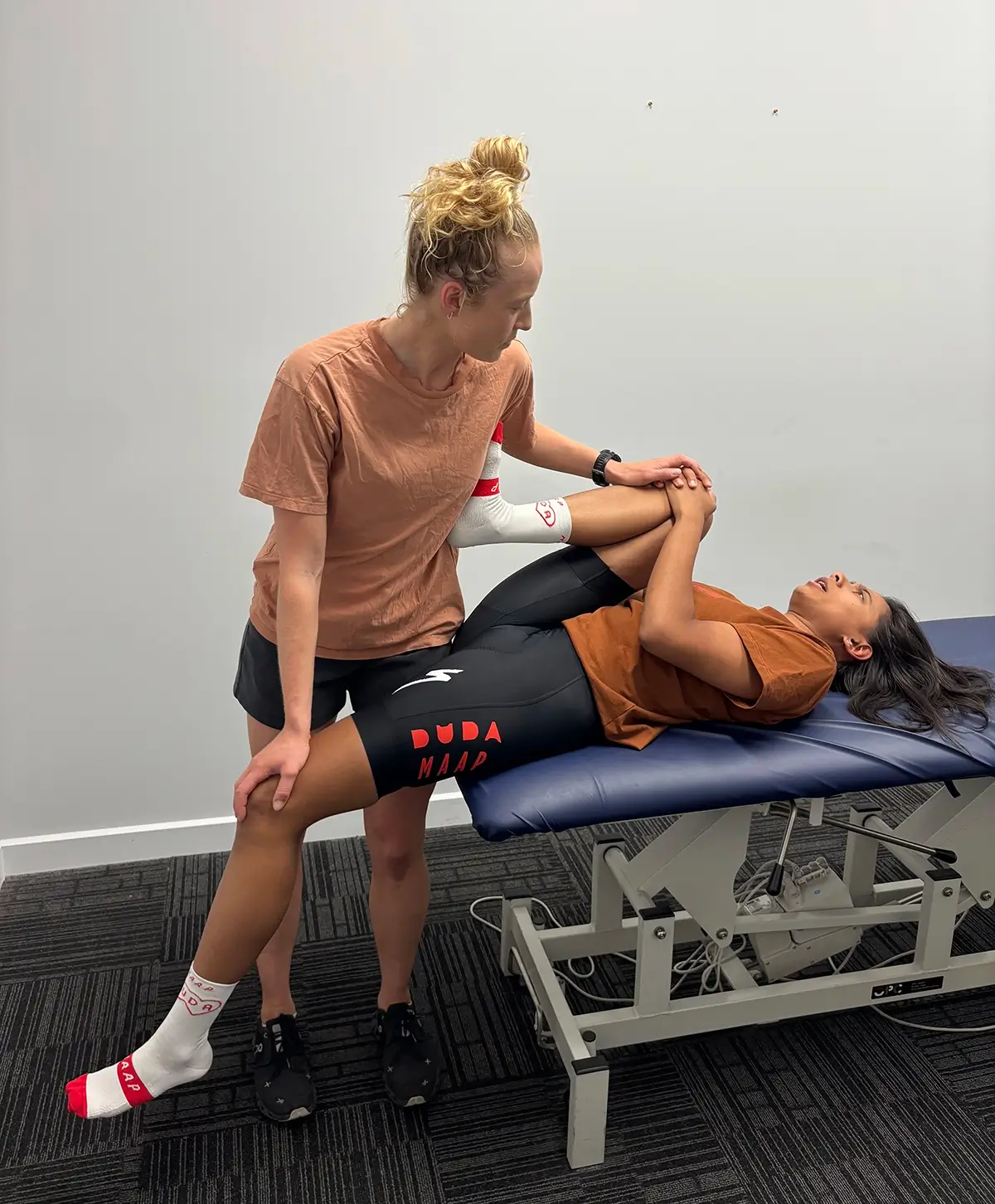
How Common in Knee Pain in Cycling?
Knee pain is common in cycling. A recent study found that up to 48% of recreational and competitive cyclists reported knee pain, of which majority experienced aggravation while cycling (Braybrooke and Cooper 2023). In professional cycling the prevalence is likely lower, however is considered a significant injury resulting in time off the bike (Clarson et al 2010).
There are many possible structures that can become irritated around the knee with cycling, with one of the most common being iliotibial band syndrome (ITBS).
What is the Iliotibial Band (ITB)?
The ITB is a tough fascial tissue that starts at the top of the hip bone (iliac crest), runs down the outside of the thigh and attaches to the outside of the knee (tibia). Two hip muscles, the gluteus maximus and the tensor fascia latae, attach to the ITB and play a role in its function. The primary role of the ITB is to provide hip and knee stability, and it may also store and release elastic energy, similar to a spring (Eng et al., 2015).
What is Iliotibial Band Syndrome?
Iliotibial band syndrome (ITBS) typically presents as pain on the outside of the knee during activities that involve repetitive knee bending and straightening, such as with cycling and running. Various theories have emerged regarding the cause of ITBS, with current evidence suggesting that it may be due to compression of the ITB as it passes over a bony prominence on the lower outside part of the thigh, called the femoral epicondyle. As a result, this can irritate the fatty tissue (bursa) that sits between the ITB and the bone (Fairclough et al., 2006). This fatty tissue helps to reduce friction, but when it is excessively compressed can cause pain. Historically, this condition was believed to be a “friction syndrome,” where the ITB was thought to rub and flick over the bony prominence, causing irritation. This means the condition is also commonly referred to as ITB friction syndrome, but recent research has challenged this theory.
What Could Cause ITB Pain in Cycling?
Reduced hip abductor strength
While there is currently no high quality evidence to suggest that reduced hip abductor strength is a risk factor for ITBS, it has been observed that individuals with ITBS have reduced hip abductor strength (Foch et al., 2023).
Reduced hip abductor endurance
Runners with ITBS have been reported to experience increased hip abductor muscle fatigue after running compared to healthy runners, indicating that individuals with ITBS may have reduced endurance or fatigue resistance in their hip abductor muscles (Brown et al., 2019). Although, this has not been researched in a cycling population, it is likely that similar findings could be found in this group.
Bike set up
An improperly bike set up such as an incorrect saddle height or cleat position may contribute to ITBS in cyclists.
Poor pedalling technique
While research has not specifically explored this in cyclists, studies in runners show that those who went on to develop ITBS demonstrated increased hip adduction and knee internal rotation (Foch et al., 2023). After developing ITBS, runners have been reported to continue to running with altered gait mechanics compared to people who do not have knee pain (Foch et al., 2023). Although there is no direct evidence in cyclists, considering the increased stress this would place on the ITB and fatty tissue under it, it is reasonable to hypothesise that similar biomechanical changes could occur.
How is ITBS Managed?
Physiotherapy is often recommended as first line management for treating ITBS which may include:
Hip strengthening exercises
Hip strengthening can improve strength, reduce pain and increase function (McKay et al,. 2020).
Hip muscle control exercises
Feeling pain may impact the function of muscles such as the gluteus maximus and the TFL, and retraining these muscles to enhance their function may help.
Foam rolling and ITB stretching
Rolling and stretching is a common treatment for ITBS and may provide temporary short term symptom relief. However, this passive approach to management by itself does not address the underlying causes.
Cycling load management
Temporary load management strategies may be included such as altering riding volume, intensity and/or terrain. This may be beneficial to keep symptoms under control.
Address cycling biomechanics
Interventions targeting cycling biomechanics for ITBS may help to reduce compressive stresses over the fatty tissue under the ITB, and may therefore help to reduce pain.
Bike Fit
A properly fitting bike set up can help to reduce load on the ITB. Your Physiotherapist can provide recommendations for bike fitting.
Shockwave therapy
Shockwave is a non-invasive treatment device that delivers rapid, short-duration acoustic waves to an area of pain. These waves carry mechanical energy through tissues and may help reduce pain. Your physiotherapist can discuss the possibility of this treatment with you.
Return to Pain Free Cycling
We help both recreational and competitive riders manage knee pain and start riding again without pain. If you’re dealing with ITB syndrome or other cycling-related injuries, Josie, our cycling physio in Melbourne, offers expert assessment and tailored treatment to help you get back on the bike with confidence.
References
Aderem, J., & Louw, Q. A. (2015). Biomechanical risk factors associated with iliotibial band syndrome in runners: a systematic review. BMC Musculoskelet Disord, 16, 356.
Althunyan, A. K., Darwish, M. A., & Abdel Wahab, M. M. (2017). Knee problems and its associated factors among active cyclists in Eastern Province, Saudi Arabia. J Family Community Med, 24(1), 23-29.
Braybrooke, A., & Cooper, D. (2023). The Prevalence and Factors Associated with Knee Pain in a sample of Cyclists within the United Kingdom: A Cross Sectional Study. Annals of Sports Medicine and Research, 10(5).
Brown, A. M., Zifchock, R. A., Lenhoff, M., Song, J., & Hillstrom, H. J. (2019). Hip muscle response to a fatiguing run in females with iliotibial band syndrome. Hum Mov Sci, 64, 181-190.
Clarsen, B., Krosshaug, T., & Bahr, R. (2010). Overuse injuries in professional road cyclists. Am J Sports Med, 38(12), 2494-2501.
Eng, C. M., Arnold, A. S., Lieberman, D. E., & Biewener, A. A. (2015). The capacity of the human iliotibial band to store elastic energy during running. J Biomech, 48(12), 3341-3348.
Fairclough, J., Hayashi, K., Toumi, H., Lyons, K., Bydder, G., Phillips, N., Best, T. M., & Benjamin, M. (2006). The functional anatomy of the iliotibial band during flexion and extension of the knee: implications for understanding iliotibial band syndrome. J Anat, 208(3), 309-316.
Foch, E., Brindle, R. A., & Pohl, M. B. (2023). Lower extremity kinematics during running and hip abductor strength in iliotibial band syndrome: A systematic review and meta-analysis. Gait Posture, 101, 73-81.
Hutchinson, L. A., Lichtwark, G. A., Willy, R. W., & Kelly, L. A. (2022). The Iliotibial Band: A Complex Structure with Versatile Functions. Sports Med, 52(5), 995-1008.
McKay, J., Maffulli, N., Aicale, R., & Taunton, J. (2020). Iliotibial band syndrome rehabilitation in female runners: a pilot randomized study. J Orthop Surg Res, 15(1), 188.
Menard, M., Lacouture, P., & Domalain, M. (2020). Iliotibial Band Syndrome in Cycling: A Combined Experimental-Simulation Approach for Assessing the Effect of Saddle Setback. Int J Sports Phys Ther, 15(6), 958-966.
The Prevalence and Factors Associated with Knee Pain in a sample of Cyclists within the United Kingdom- A Cross Sectional Study
Razie, M., Leila, K., & Saied, K. (2021). Shockwave Therapy Versus Dry Needling for the Management of Iliotibial Band Syndrome: A Randomized Clinical Trial: SWT Vs. DN for the Treatment of ITBS. Galen Med J, 10, 1-8.
Weckstrom, K., & Soderstrom, J. (2016). Radial extracorporeal shockwave therapy compared with manual therapy in runners with iliotibial band syndrome. J Back Musculoskelet Rehabil, 29(1), 161-170.
Prefer Complete Physio Richmond on Google
Add Complete Physio Richmond as a Preferred Source on Google to see more of our latest physiotherapy insights in Search.