

Knee pain in Tennis Players – A common injury we see at Complete.
Tennis season is back in full force, with the Australian Open! Tennis is a popular summer sport and is great for fitness, and coordination – but just like other sports, it can also come with injuries or niggles. Tennis injuries aren’t always caused by a single incident; more often, they develop gradually – the quick direction changes, repeated lunges, explosive sprints, and long matches can all add up over time.
At our clinic, we regularly see tennis players dealing with overuse injuries. One of the most common is patellofemoral pain; a type of knee pain that can quietly build and become hard to ignore.
What Is Patellofemoral Pain?
Patellofemoral pain refers to pain coming from or around the joint between the kneecap (patella) and the thigh bone (femur). Most players describe it as pain around or behind the kneecap, rather than in one specific spot.
It’s commonly known as “runner’s knee,” but tennis players are just as prone to it due to the repeated loading of the knee during play.
Why Tennis Players Commonly Get It
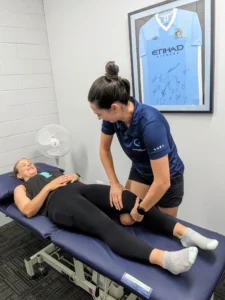
Tennis places a high demand on the knees. During training and games, players will participate in movements such as lunging forwards or sideways, change direction rapidly, and accelerate and decelerate quickly. If the knee is doing too much and doesn’t have good support of surrounding areas and muscles, this can develop into patellofemoral pain. Some factors that can lead to knee pain include:
- Weak gluteal muscles or thigh muscles (including quadriceps and hamstrings)
- Poor knee control
- Sudden increase or spike in training or match load
- Sometimes footwear could be contributing
- Or even the type of surface
What you can do to help prevent knee pain
Some quick and easy things you can implement to assist with your tennis and help prevent knee pain can be the following:
- Strength training – improve strength in your hips, quadriceps and hamstrings
- Manage your training load. In short, don’t do too much too soon, and have rest days
- Incorporate a proper warm up and a proper cool down
When Should You Get It Checked?
If knee pain has been hanging around for more than a couple of weeks, is getting worse, or is affecting your performance on court, it’s worth getting it assessed. Early treatment usually means a quicker and smoother return to playing pain-free and fortunately, patellofemoral pain responds very well to physiotherapy! With the right guidance and a tailored rehab plan, most players can get back on court stronger and more confident than before. If you’re dealing with knee pain or any tennis-related injury, our team is here to help.
Prefer Complete Physio Richmond on Google
Add Complete Physio Richmond as a Preferred Source on Google to see more of our latest physiotherapy insights in Search.