

Guyon’s Canal Syndrome is a common wrist injury in cycling. It can present as hand muscle weakness and/or pain, tingling, pins, needles and/or numbness over the pinky finger and half of the ring finger.
What Causes Guyon’s Canal Syndrome?
Guyon’s Canal Syndrome occurs when the ulnar nerve gets compressed as it passes through Guyon’s canal, which is located between two bony projections on the palm side of the hand beneath the pinkie finger. The ulnar nerve provides sensation to the pinkie and half of the ring finger, and innervates most of the intrinsic hand muscles. Symptoms of nerve compression will vary depending on what part of the nerve gets compressed.
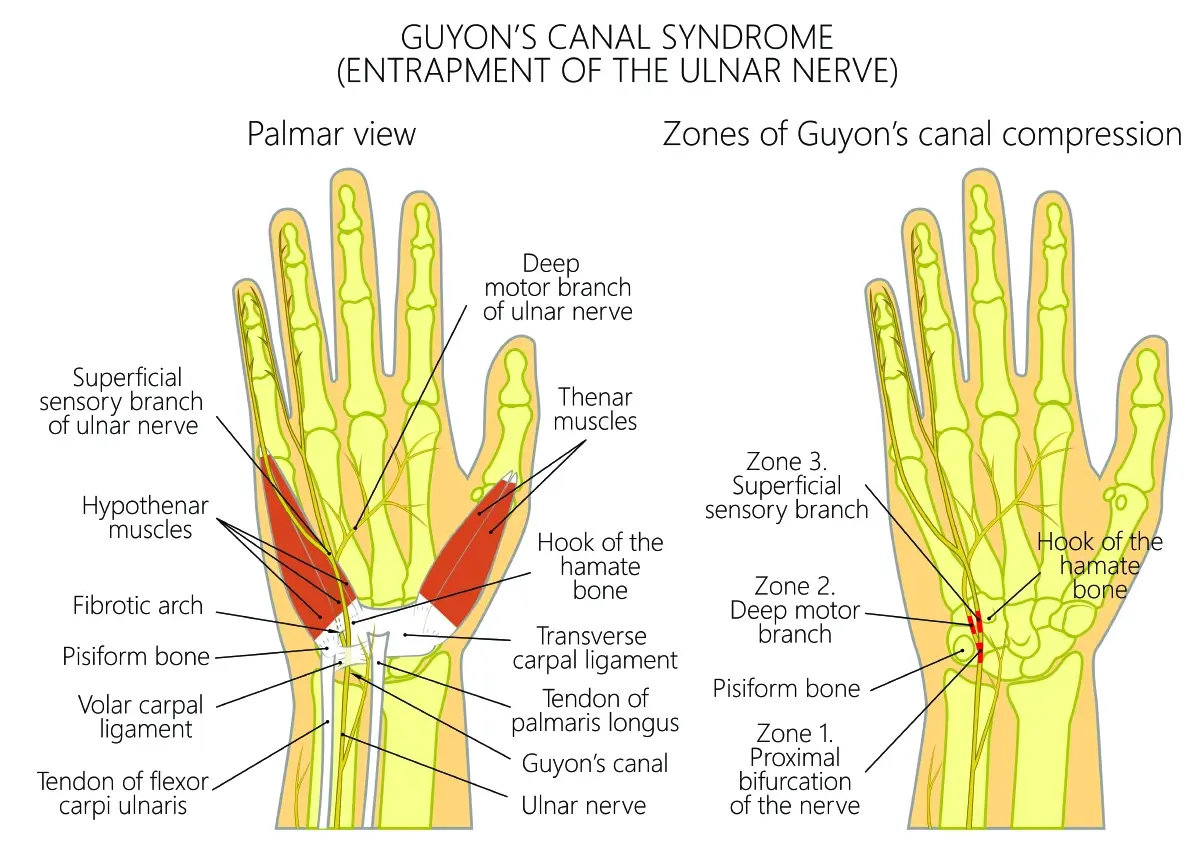
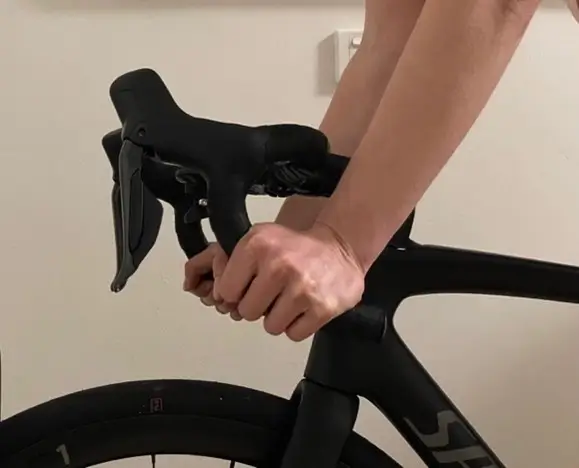
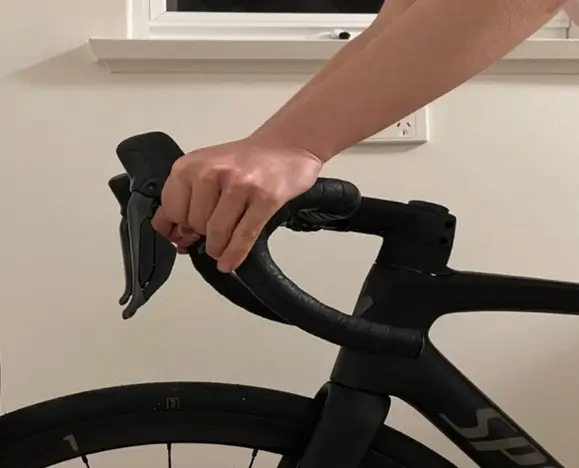
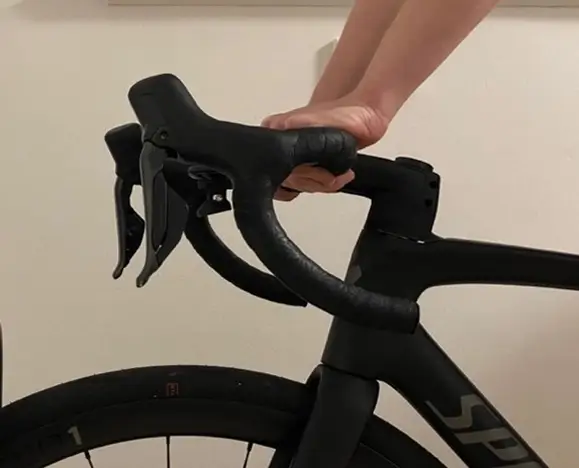
In cycling, constant pressure and gripping of the handlebars from an inadequate bike setup can compress and irritate the ulnar nerve. This can be worsened when cycling downhill or when cycling in the drops, which shifts more weight onto the handlebars. Additionally, poor wrist posture, such as holding the wrist in ulnar deviation or hyperextension, can increase compression. Research has found that the ulnar nerve is more likely to get compressed in these positions than a neutral wrist posture (Rauch et al., 2016). The photos below show the different positions in which the ulnar nerve can get compressed.
Drops
Hoods
Tops
How is Guyon’s Canal Syndrome diagnosed?
A physiotherapy assessment is recommended to help determine the diagnosis and the most appropriate treatment plan. This will typically involve an assessment of:
- Hand muscle strength
- Skin sensation test to the pinkie and ring finger
- Wrist range of motion and posture
- Cervical (neck) and thoracic (upper back) spine
- Cervical (neck) and core muscle strength
How to manage Guyon’s Canal syndrome?
There is currently limited high-quality evidence on managing Guyon’s Canal Syndrome (Chiaramonte et al., 2022). However, common management strategies include:
- Physiotherapy rehabilitation exercises – These may include spinal and nerve mobility exercises and strengthening exercises. For cyclists recovering from injury or enhancing performance, we offer specialised cycling physiotherapy in Melbourne.
- Bike fit – A professional bike fit is recommended to reduce hand pressure on the handlebars (Chiaramonte et al., 2022). This issue often stems from an incorrect saddle height and/or tilt that is resulting in pressure being shifted towards the handlebars. Chat to your Physiotherapist about possible bike fit modifications and/or referral to an expert bike fitter.
- Wear padded gloves – A study of un-injured experienced cyclists found that wearing padded gloves significantly reduce pressure on the hand compared to wearing no gloves or gel gloves, when cycling in various hand positions (tops, hoods and drops position).
- Wrist splinting – Splinting for between 1 and 12 weeks may help assist with the management of Guyon’s Canal Syndrome (Hoogvliet et al.,2013)
- Regular posture changes while riding – Changing your wrist posture by alternating hand positions between the tops, hoods, and drops may help reduce compression (Chiaramonte et al., 2022)
References
– Chiaramonte, R., Pavone, P., Musumeci, G., Di Rosa, M., & Vecchio, M. (2022). Preventive strategies, exercises and rehabilitation of hand neuropathy in cyclists: a systematic review. Journal of Hand Therapy, 35(2), 164-173
– Hoogvliet, P., Coert, J. H., Fridén, J., & Huisstede, B. M. A. (2013). How to treat Guyon’s canal syndrome? Results from the European HANDGUIDE study: a multidisciplinary treatment guideline. British journal of sports medicine, 47(17), 1063-1070
– Rauch, A., Teixeira, P. A. G., Gillet, R., Perez, M., Clerc-Urmes, I., Lombard, C., & Blum, A. (2016). Analysis of the position of the branches of the ulnar nerve in Guyon’s canal using high-resolution MRI in positions adopted by cyclists. Surgical and Radiologic Anatomy, 38, 793-799
– Slane, J., Timmerman, M., Ploeg, H. L., & Thelen, D. G. (2011). The influence of glove and hand position on pressure over the ulnar nerve during cycling. Clinical Biomechanics, 26(6), 642-648
Prefer Complete Physio Richmond on Google
Add Complete Physio Richmond as a Preferred Source on Google to see more of our latest physiotherapy insights in Search.