

Patellofemoral joint (PFJ) instability is frequently mismanaged in the early weeks after a first dislocation. This guide lays out practical principles to improve early care and long-term outcomes.
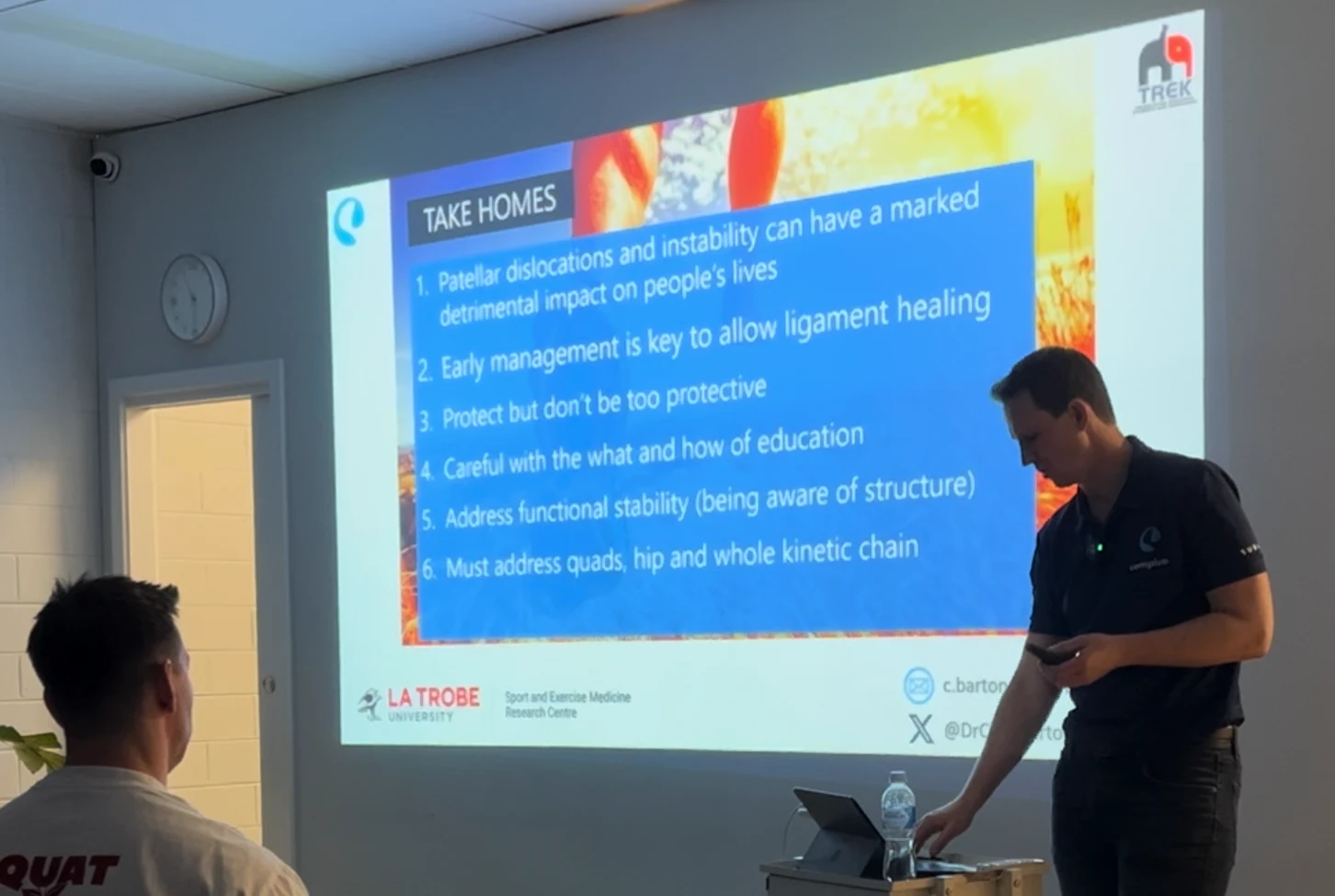
This article is based on my presentation at the PFJ Masterclass, held at Complete Physio Richmond.
Anatomical & Structural Considerations
Before planning rehab, it helps to map the main structural factors that can raise instability risk. Here are the common factors we consider in clinic:
- Trochlear dysplasia – shallow/flat groove reduces containment.
- Patella alta – higher patellar position lowers congruence and stability.
- Q-angle/valgus – emphasise dynamic alignment, not only static.
- Ligamentous laxity/MPFL injury – recurrent cases may need surgical input.
- Hypermobility & muscle imbalance – weak medial quads/gluteals plus lateral tightness commonly drive symptoms.
Case Example – Rhys’ Story
To understand why early management matters, consider Rhys, who progressed from a teenage dislocation to patellar replacement by 30 after mostly passive care. His journey highlights the value of education and structured, progressive exercise.
You can learn more about Rhys, a patient at our clinic who shared his story on SBS Insight: “I lived on pretty much any pain medication I could get my hands on” – and in this article on high value care and the lessons it offers for physiotherapy.

Acute Management: First 72 Hours
The first 72 hours set the tone for healing. Protect the joint, much like a significant ankle sprain.
- Consider a Zimmer splint near 0° with crutches to offload.
- Avoid anti-inflammatories if you can, as they may suppress the normal healing response.
- Prioritise calm reassurance and a clear plan for the next two weeks.
Subacute Phase (Day 3 onwards)
From day three, the goal is to balance protection with preventing immobilisation harms. We want motion and muscle activity without provoking instability.
- Begin controlled ROM (0–30°) in the first two weeks.
- Start isometric quads at ~30° to reduce irritation risk (the PFJ is quite unstable when loaded in the last 30°).
- Progress to partial weight-bearing around days 7–10.
Taping
Taping boosts confidence and immediate function while you rebuild strength. Taping can be helpful during subacute and rehabilitation phases. The following can be helpful (see video for further guidance):
- Use medial glide/tilt patterns for short-term symptom relief.
- Add inferior (distal) pull if patella alta is present.
- Braces can help, but may not be as effective or comfortable as taping.
Rehabilitation Beyond the Acute Phase
Strength & Range Progression
Range and loading should expand together in a controlled arc. Aim for these milestones:
- Weeks 2–4: progress ROM toward ~90°, with full ROM ~6 weeks.
- Emphasise isometrics initially, and progress to isotonic quads/hamstrings with a medial bias.
- Introduce closed-chain work from around week 5; plyometrics typically from week 6 to 8.
Avoiding Irritation
Strategic exercise choices keep symptoms quiet while strength builds. Follow these guardrails:
- Limit terminal extension (last 20–30°) early in open-chain work.
- Prefer leg press/squat patterns over heavy open-chain near extension.
- Build strength and power—athletes need both for return to sport.
In most cases, no. I regularly see runners who injure themselves because they tried to change how they run.
Hip & Kinetic Chain
PFJ mechanics are influenced by many things, some not immediately obvious. Targeting the hip and whole chain often normalises tracking more efficiently than local knee work.
- Prioritise gluteal strength and control of femoral internal rotation.
- Combine hip + knee rehab over time for best results.
- Address lateral hamstring and quadriceps tone when it’s clearly limiting function.
These strategies are also highly relevant for people with patellofemoral pain – see our Patellofemoral Pain page for more details.
Psychological & Educational Factors
Words shape outcomes. Clear education reduces fear, keeps people moving, and prevents disability spirals.
- Identify and address kinesiophobia (fear of pain and movement) with reassurance and graded exposure.
- Avoid catastrophising about structure; frame what’s changeable.
- Reinforce that exercise is safe and central to recovery.
Recurrent Instability
When dislocations persist despite solid rehab, surgical stabilisation becomes a fair consideration. Use surgery chiefly to reduce episodes of instability, noting pain responses can vary.
Key Takeaways
If you remember only a few things, make them these.
- Protect early – but don’t overprotect.
- Progress ROM and load in tandem; start isometric,and build to address muscle power.
- Train hip + knee + the whole kinetic chain, not just the patella.
- Educate to reduce fear, not to amplify it.
- Reserve surgery for true recurrent instability after quality rehab.
Thanks to everyone who joined the PFJ Masterclass at the clinic. Please reach out to us at Complete. Physio if we can help.
Prefer Complete Physio Richmond on Google
Add Complete Physio Richmond as a Preferred Source on Google to see more of our latest physiotherapy insights in Search.